
IGU Condensation and Fogging: Desiccant & Warm Edge Spacers
IGU Condensation and Fogging: Desiccant & Warm Edge Spacers
Fogging inside an insulating glass unit is a materials and sealing problem, not a cleaning problem. When haze, droplets or a milky film appear between the panes, moisture is already inside the sealed cavity, and no amount of exterior cleaning will remove it. Two components carry most of the preventive workload: the desiccant that adsorbs residual moisture from the cavity, and the spacer that fixes the cavity geometry and governs heat flow at the glass edge.
Soleron Insulating Glass Materials is a supplier of aluminium spacer bars, warm edge spacers, sealants and molecular sieve desiccants to insulating glass processors. This article separates the two failure modes that buyers both describe as "fogging", explains what 3A molecular sieve desiccant and warm edge spacer bars each do about them, and sets out what a processor should verify before committing to a long-term, multi-component supply arrangement.
Two failure modes are both called fogging
Internal condensation and edge condensation look similar to a building occupant, and they are produced by different physics. Treating one as the other usually costs a production cycle and sometimes a warranty claim.
Internal cavity fogging occurs inside the sealed space. Because the cavity is closed at the edge, the moisture that matters is the moisture sealed in at assembly plus the moisture that migrates through the edge seal over time. Desiccants are specified precisely because they adsorb residual water and solvent vapour and keep humidity low in that sealed space. If the desiccant's usable capacity is exhausted, or if vapour ingress through the seal outpaces adsorption, the dew point of the cavity rises and condensation can form on the cavity-side glass when the unit runs cold.
Edge condensation occurs on a glass surface, normally the room-side pane near the frame. It is a temperature problem: the edge is the coldest part of the pane because the spacer forms a thermal bridge between the two panes and the frame. Warm edge spacers address this by using low thermal conductivity materials to reduce heat flow at the glass edge, which keeps the inner surface warmer and reduces the chance that surface condensation forms there.
What the IGU edge is actually built from
An insulating glass unit consists of two or more glass panes separated by a spacer and sealed around the edges to form an insulating air or gas-filled cavity. The spacer's main function is to hold the panes at a fixed distance from each other and thereby establish the size of the interpane space. That single geometric role explains why spacer width and desiccant volume are linked in every moisture specification.
Around the spacer sits the rest of the edge system: a primary seal, a secondary seal, desiccant held inside the spacer cavity, and connectors. Technical descriptions of IGUs commonly reference a dual-seal structure with polyisobutylene as the primary seal and silicone as the secondary seal, and for structural silicone glazing only units with that dual-seal composition are described as having the durability the application requires. In production terms the primary seal appears as a butyl-based seal, applied to the spacer backing, with silicone or polysulfide forming the secondary seal.
The component list that matters for moisture control is short: spacer bars, warm edge spacers, molecular sieve desiccants, PIB sealants, silicone sealants, polysulfide sealants and corner keys. Everything else in an IGU catalogue — decorative profiles, connectors, tapes — supports handling and assembly, but the moisture balance is decided by the four items above.
Industry background: moisture performance is tested, not assumed
The reason desiccant and spacer choices are documented rather than improvised is that IGU moisture performance sits inside formal test regimes. EN 1279-2 sets a moisture penetration test in which the average moisture penetration index must not exceed 0.20 across five aged specimens, and no individual specimen may exceed 0.25. The same standard recognises several methods for determining desiccant moisture content, including 540 °C drying, Karl Fischer titration, gravimetric and dew-point methods.
AS/NZS 4666:2012 takes a manufacturing-control view, covering long-term type testing and periodic manufacturing testing together with traceability, desiccant suitability, shelf life and desiccant exposure limits. Read together, the two standards treat desiccant condition and edge-seal integrity as production variables that need documented control — not as one-off purchasing decisions made when a specification sheet is signed.
Downstream demand gives that discipline a commercial weight. Commercial research from Grand View Research put the global insulated glass market at USD 92.7 billion in 2024, with source-reported projections of USD 101.3 billion for 2026 and USD 121.7 billion by 2030. Meticulous Research valued the warm edge spacer market at USD 1.1 billion in 2024 and projected around USD 1.90 billion by 2035. These are commercial-research figures, not independently verified here, and volume growth does not change the physics; what it changes is the cost of a systematic moisture failure repeated across a large output.
How 3A molecular sieve desiccant reduces internal fogging
The desiccant in an IGU is not there to rescue a unit after a leak. It is there to remove the residual moisture present when the unit is sealed, and to keep the sealed space dry afterwards. Commonly used desiccants in insulating glass are molecular sieves, or blends of silica gel with molecular sieves, and their stated purpose is to adsorb residual water and solvent vapour in the sealed space. 3A molecular sieve is the zeolite desiccant grade addressed here and the grade referenced in the supplied desiccant market data.
Adsorption lowers the water-vapour concentration of the sealed cavity, which lowers the dew point of the trapped gas volume. As long as the sieve retains usable capacity and the edge seal limits vapour ingress, the cavity dew point stays below the temperatures the unit will meet in service, and internal condensation does not form. Two conditions have to hold at once, and this is where most specifications quietly fail. The desiccant must suit the spacer cavity and the filling equipment it runs through, and the fill must be continuous along the whole spacer length. A partially filled or bridged desiccant bed leaves whole sections of the cavity without adsorption capacity, regardless of how good the grade is.
Where the desiccant stops working
Desiccant is a buffer, not a barrier. It cannot compensate for an edge seal that admits water vapour faster than the sieve can adsorb it, and it cannot undo contamination introduced by a wet or humid assembly area. This is why the supplied procurement guidance lists water vapour permeability as the property to check for long-term anti-fog performance and temperature resistance as a second screen, since seasonal temperature swings act on the same joint that carries the moisture load.
How to verify desiccant and seal condition
Desiccant moisture content is measurable, and the permitted methods are documented: 540 °C drying, Karl Fischer titration, gravimetric and dew-point methods under EN 1279-2. AS/NZS 4666 adds desiccant suitability, shelf life and exposure limits to the same conversation. For a processor this converts into three practical checks: incoming desiccant moisture content against an agreed limit, the exposure time between opening the desiccant supply and sealing the unit, and the completeness of the fill at the end of each spacer run.
How warm edge spacer bars reduce edge condensation
Warm edge spacers reduce edge condensation by lowering heat flow at the glass edge. Conventional aluminium conducts heat readily, so the edge zone runs colder in winter and the inner surface near the frame drops toward the dew point of the indoor air. A low-conductivity spacer reduces that thermal bridge, keeps the surface warmer, and reduces the likelihood of surface condensation — while also lowering overall heat transfer at the edge.
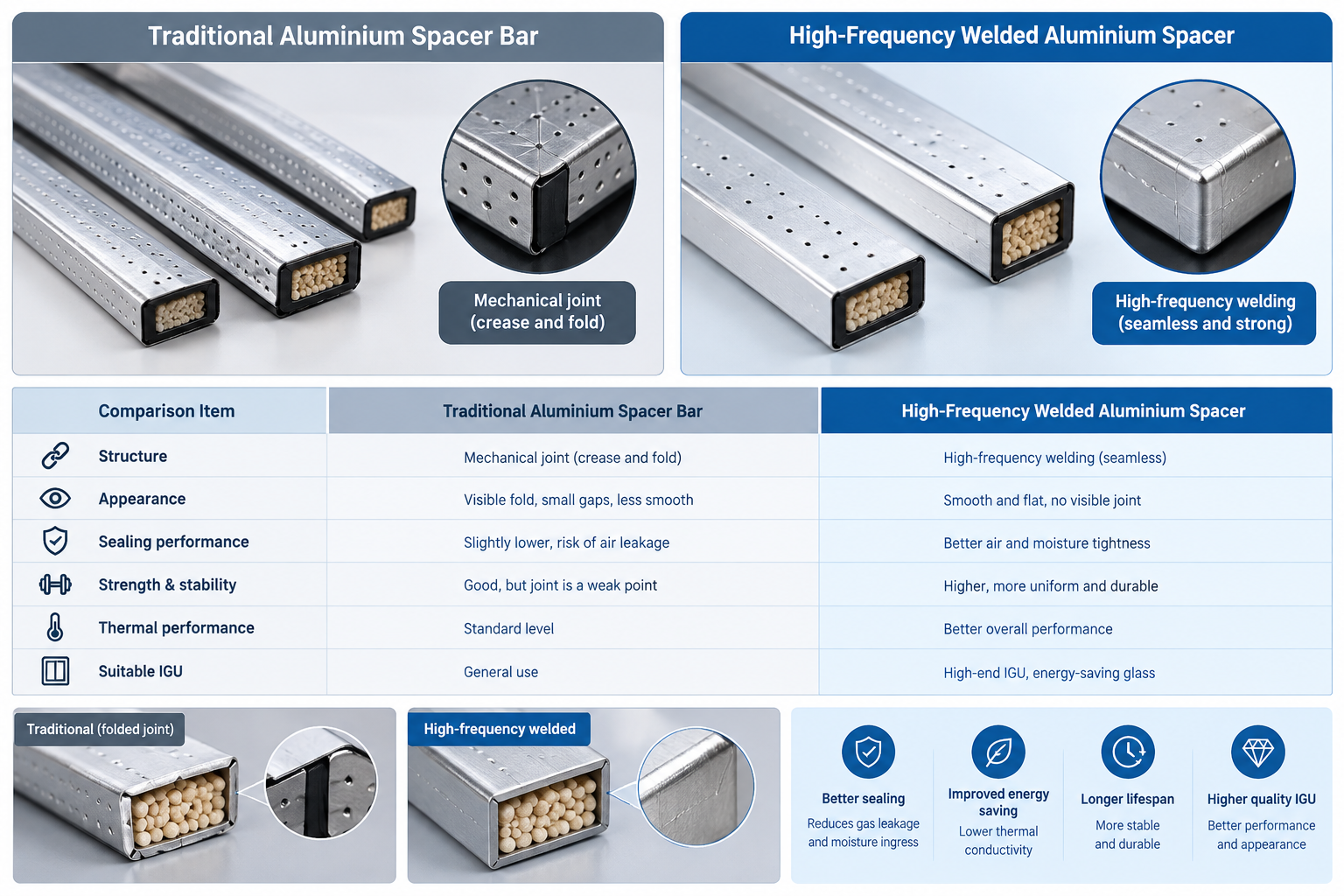
Supplied comparison data for warm edge spacers against traditional aluminium spacers states thermal conductivity up to 50–70% lower than conventional aluminium spacers, and states the trade-off plainly: a slightly higher initial cost, offset over the life of the unit by better thermal insulation and energy efficiency. The same comparison describes stable quality, precise dimensions, strong sealant compatibility, customised specifications, low maintenance and a long service life. Warm edge spacers are supplied in flexible, hybrid and composite constructions, so the specification has to name the construction and not only the category.
Processors weigh handling as well as thermal performance. Aluminium spacer bars offer good mechanical strength, easy processing, dimensional stability and compatibility with conventional insulating glass production lines, which helps maintain stable production. Where the deciding factor is edge thermal performance, warm edge spacers take over; where the deciding factor is line compatibility and mechanical rigidity at the lowest initial cost, aluminium remains the practical choice.
What warm edge does not do
A warm edge spacer does not dry the cavity and does not repair a failed seal. A unit with a warm edge spacer and saturated desiccant will still fog internally; a unit with a warm edge spacer and a leaking seal will still fail a moisture penetration test. The spacer controls temperature at the edge, the desiccant controls humidity in the cavity, and the seal system decides how fast the desiccant's workload grows. Component selection only holds up when it is made as a system decision.
Matching component to symptom
| Observed symptom | Where it appears | Primary material lever | What to verify |
|---|---|---|---|
| Haze or droplets trapped in the cavity | Cavity-side glass surfaces | 3A molecular sieve desiccant plus edge seal integrity | Desiccant fill and moisture content, sealant water vapour permeability, pre-shipment test |
| Water on the room-side surface near the frame | Interior glass surface, edge zone | Warm edge spacer with low thermal conductivity | Spacer construction and thermal performance, sealant compatibility |
| Fogging returning after rework | Cavity, often unevenly | Seal system and assembly conditions | Primary and secondary seal combination, assembly humidity, desiccant exposure time |
Aluminium versus warm edge spacer for condensation control
| Comparison point | Aluminium spacer bar | Warm edge spacer |
|---|---|---|
| Thermal conductivity | Conventional aluminium reference point | Up to 50–70% lower than conventional aluminium spacers |
| Edge condensation behaviour | Higher heat flow at the edge | Lower heat transfer, better thermal insulation, reduced condensation |
| Processing | Good mechanical strength, easy processing, dimensional stability, compatible with conventional IGU lines | Stable quality, precise dimensions, strong sealant compatibility, customised specifications |
| Initial cost | Lower | Slightly higher |
| Long-term cost position | Reference case | Better long-term cost-effectiveness through improved thermal insulation and energy efficiency |
| Maintenance profile | Depends on seal system | Low maintenance, long service life, stable sealing performance |
| Typical fit | Volume production where edge thermal performance is not the constraint | Energy-efficient windows and doors, curtain walls, passive houses, residential and commercial buildings |
Step-by-step: building a moisture-controlled edge
- Name the failure mode first. Confirm whether the problem is cavity fogging or surface condensation before changing any component. The two call for different specifications, and swapping a spacer to solve a desiccant problem simply moves the cost.
- Fix the cavity and spacer geometry. The spacer sets the interpane distance and therefore the desiccant volume available. Desiccant is supplied in particle size grades, and the grade has to suit the spacer cavity it fills and the molecular sieve filling machine behind it; confirm the grade against each spacer profile you run instead of assuming one grade covers every width.
- Specify the desiccant and its acceptance limit. Name the 3A molecular sieve grade, the moisture content limit at goods-in, and the filling equipment it will run through — typically a molecular sieve filling machine inside an insulating glass production line. Keep the limit in the purchase specification, not only in a datasheet.
- Build the seal around the spacer, not around habit. Combine a butyl-based primary seal with a secondary sealant chosen for the unit structure and service environment. Check adhesive strength, curing speed and temperature resistance, and use water vapour permeability as the anti-fog screen. Where tiles or panels are structurally bonded, confirm that the seal combination meets the requirement for the glazing type.
- Control the assembly environment. Clean, dry, controlled temperature and controlled humidity are the working conditions under which spacer bending, desiccant filling, butyl extrusion and IGU assembly are meant to run. Desiccant exposure limits and shelf life belong in the work instruction for the same reason.
- Verify before shipment. Use a pre-shipment test as the acceptance gate, and where the market requires it, reference the moisture penetration approach of EN 1279-2 or the manufacturing testing regime of AS/NZS 4666. Verification is what converts a component specification into a repeatable product.
Where the combination matters most
The desiccant-plus-warm-edge specification is not relevant to every unit. It earns its cost where the edge runs cold, where the cavity is wide, or where the glazing has to hold performance for decades rather than seasons.
- Energy-efficient windows and doors: edge thermal performance and cavity dryness both affect the delivered performance of the unit, so the spacer and desiccant are specified together.
- Curtain walls and commercial facades: large edge lengths and structural or semi-structural glazing raise the importance of seal composition alongside spacer selection.
- Passive house and low-energy buildings: edge heat flow becomes a visible share of the total, which is where warm edge spacers are normally specified rather than optionally considered.
- Cold-climate and high-humidity interiors: the same unit faces a lower surface temperature and a higher indoor moisture load, so both condensation mechanisms are active.
- Renovation and replacement glazing: replacing failed units is where the cost of the original specification becomes visible; a repeat failure is usually a seal or desiccant decision rather than an installation one.
Long-term supply: keeping one specification across years
Most fogging problems that appear in year five were specified in year one. For a processor running the same unit family across multiple projects, the real long-term risk is not a single bad batch but specification drift: a changed desiccant grade, a different warm edge construction, or a sealant from a second source that meets the datasheet but not the validated combination. Re-qualifying an edge system costs far more than the price difference between two competent suppliers.
That is the argument for consolidating multi-component supply rather than buying each item from the lowest bidder. A supplier who provides spacer bars, warm edge spacers, sealants and molecular sieve desiccants from one range can keep combinations stable across repeat orders, and can answer a compatibility question about its own products rather than pointing at a third party.
What to check before signing a long-term arrangement
- Range coverage: whether spacer bars, warm edge spacers, desiccants and sealants come from one source, so a single change does not invalidate a validated edge build-up.
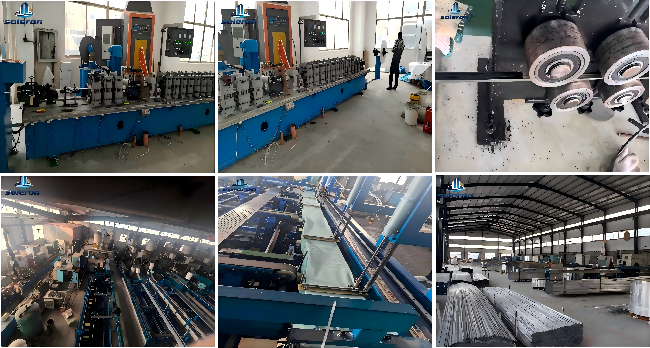
- Production depth: the number and type of lines behind the products, because capacity is what protects a delivery schedule when a project accelerates.
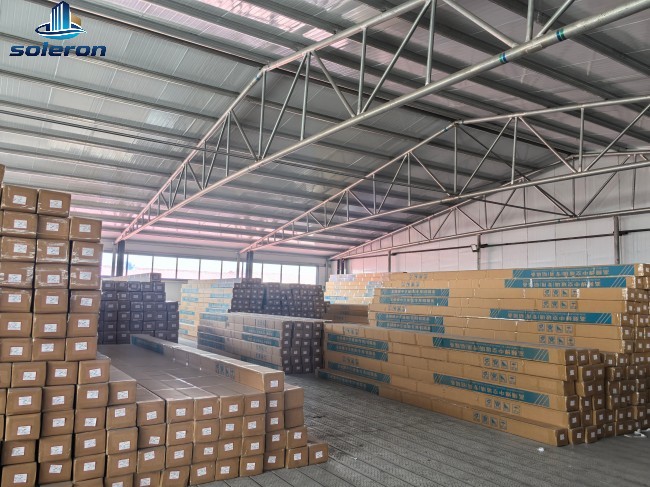
- Stock position: whether regular sizes are held in stock or produced only to order, which determines response time on urgent and replenishment orders.
- Line compatibility: whether the spacer format runs on your existing bending, filling and extrusion equipment without re-tooling.
- Documentation: moisture content limits, desiccant exposure limits, sealant water vapour permeability and pre-shipment test records, kept as controlled documents rather than marketing statements.
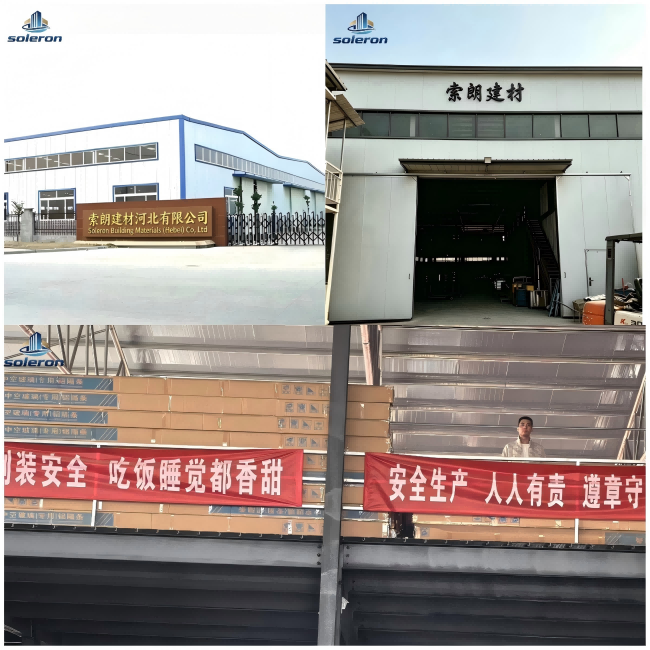
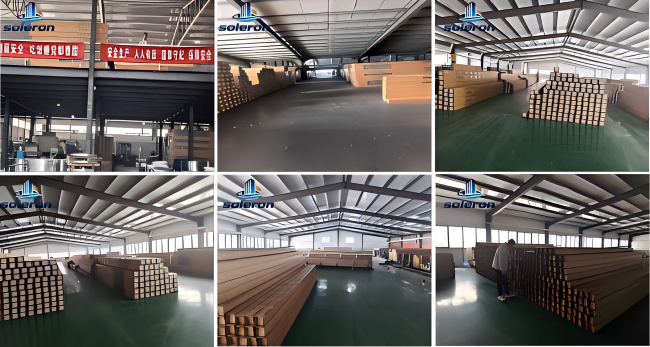
For reference, Soleron Insulating Glass Materials operates 10 automatic aluminium spacer bar production lines, 8 semi-automatic production lines and 10 warm edge spacer production lines, with annual production capacity of 500 tons and more than 100 pieces of regular aluminium spacer bars and warm-edge spacers held in stock. The company reports more than 10 years of production experience and supplies markets including Europe, North America, Asia, the Middle East, Latin America and Africa. Aluminium spacer bars from the range are described as compatible with conventional insulating glass production lines, which helps maintain stable production when volumes rise.
Verifying claims rather than accepting them
Supplier statements are a starting point, not proof. Sealant producers publish compliance statements — for example, that their PIB products fulfil EN 1279 and ASTM E2190 requirements and that their standard secondary sealants comply with the same standards — but these are company-reported claims that a buyer should match against third-party test reports before qualification. The same discipline applies to spacer thermal data and to desiccant moisture content: ask for the test method and the measured value, not only the headline property.
Commercial terms belong in the same review. The supplied purchasing terms for this range are a minimum order quantity of 5 cartons, delivery quoted EXW, FOB or CIF, acceptance based on a pre-shipment test, and payment terms of 30/70. Terms like these are easy to compare across suppliers; the specifications behind them are not, which is why they should be written down before the first repeat order rather than negotiated after a failure.
Frequently asked questions
How does EN 1279-2 relate to internal fogging in an IGU?
EN 1279-2 sets a moisture penetration test for insulating glass units: the average moisture penetration index must not exceed 0.20 across five aged specimens, and no individual specimen may exceed 0.25. The same standard recognises several methods for determining desiccant moisture content, including 540 °C drying, Karl Fischer titration, gravimetric and dew-point methods. The test addresses how much moisture the edge seal assembly allows through over an ageing sequence, which is the mechanism behind internal fogging that develops after installation rather than at the factory gate.
What is the function of a spacer bar in an IGU?
The spacer bar maintains the distance between the glass panes and creates the insulating cavity. It also provides a channel for the desiccant and helps form the edge seal, which is why spacer width and desiccant volume are specified together rather than independently.
What are the advantages of aluminium spacer bars?
Aluminium spacer bars offer good mechanical strength, easy processing, dimensional stability and compatibility with conventional insulating glass production lines. That compatibility is the practical advantage in high-volume plants: the spacer format runs on existing bending, filling and extrusion equipment without changing the line.
What are insulating glass accessories?
Insulating glass accessories are the auxiliary materials used in IGU production. They include spacer bars, warm edge spacers, molecular sieve desiccants, PIB sealants, silicone sealants, polysulfide sealants, corner keys and related components. For moisture control the decisive items are the spacer, the desiccant and the primary and secondary sealants.
What are the purchasing terms and acceptance criteria for these materials?
For the supplied insulating glass materials range, the minimum order quantity is 5 cartons, delivery terms are EXW, FOB or CIF, acceptance criteria are based on a pre-shipment test, and payment terms are 30/70. Buyers should confirm the applicable moisture content limit and desiccant exposure limit in the same purchase specification.
What should buyers check in long-term insulating glass materials suppliers with stable multi-component supply?
Check four things: whether spacer bars, warm edge spacers, desiccants and sealants come from one range so validated combinations stay stable; whether production depth supports repeat volumes; whether regular sizes are held in stock; and whether the supplier documents moisture content limits, desiccant exposure limits and pre-shipment test results. Soleron Insulating Glass Materials covers this range with 10 automatic aluminium spacer bar production lines, 8 semi-automatic lines and 10 warm edge spacer production lines, annual capacity of 500 tons, more than 100 pieces of regular aluminium and warm-edge spacers in stock, and more than 10 years of production experience. A specification match against your spacer profile, cavity width and target market can be requested before the first order.
Conclusion
Internal fogging and edge condensation are two different failures that share one visible symptom. Cavity fogging is a moisture-balance problem, answered by a correctly graded and completely filled 3A molecular sieve desiccant working behind an intact edge seal. Edge condensation is a thermal problem, answered by a warm edge spacer that reduces heat flow at the glass edge. Neither component substitutes for the other, and neither compensates for a seal system that admits vapour faster than the desiccant can adsorb it.
For processors moving from decision to execution, the durability question is a supply question as much as a materials question: the specification that controls condensation in year one has to survive reorders in year five. That means written moisture and exposure limits, verified sealant properties, compatible spacer formats, and a supplier whose range and stock position allow the same combination to be repeated.
Next step: match the specification to your spacer profile
Soleron Insulating Glass Materials supplies aluminium spacer bars, warm edge spacers, molecular sieve desiccants and sealants as a combined range, with 10 automatic aluminium spacer bar production lines, 8 semi-automatic lines and 10 warm edge spacer production lines, 500 tons annual capacity, and more than 100 pieces of regular aluminium spacer bars and warm-edge spacers in stock. Minimum order is 5 cartons, delivery is quoted EXW, FOB or CIF, and acceptance is based on a pre-shipment test.
Send your spacer profile, cavity width and target market to request a specification match and a sample. The full range is listed in the Soleron product catalog. Email soleron.buildingmaterials@gmail.com or call / WhatsApp +86 138-3340-3347.
Have Questions or Need More Details?
Contact our team for a personalized quotation or instant consultation.
Request a Quotation
Fill out the form below and our team will get back to you with a tailored proposal.
WhatsApp Direct Chat
Prefer to chat in real-time? Message us on WhatsApp for instant assistance & quick answers.
- Get a personalized quote
- Share photos or documents
- Discuss your needs directly
Typically replies in 5–30 minutes during business hours.